Starting from a chance tasting experiment, deconstruct the core variables that determine 'harsh' and 'smooth' in tobacco blend formulation.
Leaf blend framework, nicotine form, sugar-acid balance, additives and moisture -- every link rewrites the sensory signal your throat receives.
The Basic Logic of Tobacco Blend Formulation — Why Some Cigarettes Are "Harsh" and Others "Smooth"
In mid-November 2023, I was in a small processing workshop near Yuxi, Yunnan, staring at two trays of cut tobacco with nearly identical alkaloid content. The electronic scale showed about 2.1% total alkaloids in Tray A and about 2.2% in Tray B. By most people's intuition, the two cigarettes should feel similar in "strength." Yet in a blind test of 8 people, 7 described A as "throat-punching, nose-stinging, like being hit with black pepper then swallowed," while B was described as "soft on the mouth, the smoke forms a ball, only a thin presence in the throat." In the same session records, the smoke pH of A was measured on the more alkaline side, while B, after Burley casing sugar and organic acid system adjustment, had higher acidity. That night I wrote only one sentence in my notebook: What determines "harsh/smooth" is never just a single nicotine number — it is the equation written jointly by nicotine form, sugars, acids, additives, and moisture at the moment of combustion.
This article breaks down that equation. No brand gossip, only formulation logic: why some cigarettes hit you right away, while others with not-low nicotine still feel smooth, silky, and pleasant to smoke.
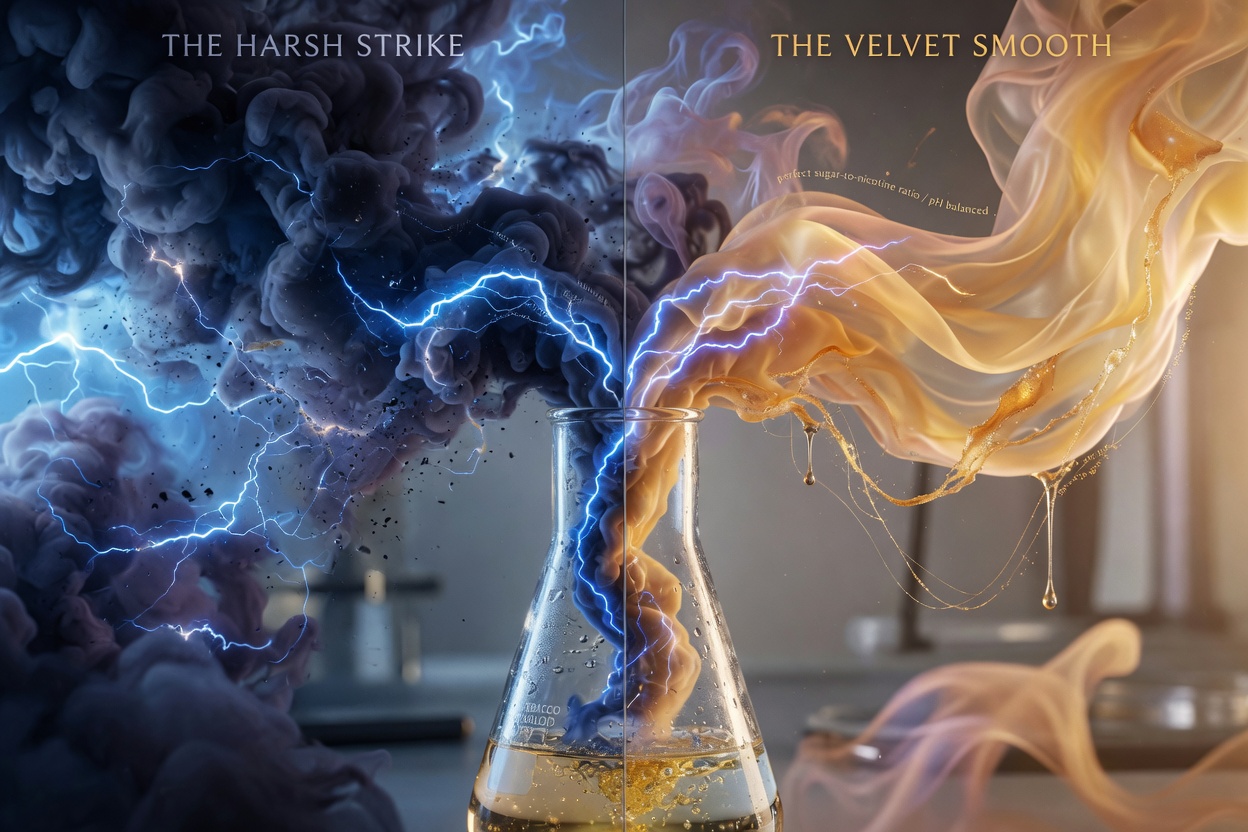
I. What Are "Harsh" and "Smooth" Really Evaluating?
On the tasting table, "harsh" is usually not just "satisfying," but a combination of several sensations:
- **Impact**: Nicotine-related, central nervous system and throat "coming up" force.
- **Irritation**: Throat dryness, pricking, spiciness, astringency, cough impulse — often related to dryness, particulate feel, certain combustion products, and elevated pH.
- **Dryness and scraping sensation**: When smoke moisture and humectant system are unbalanced, it feels like sandpaper on the throat wall.
- **Bitterness, ammonia sensation, off-notes**: When nitrogen compounds and processing are inadequate, they dirty the "kick," making people mistakenly think it's "especially harsh."
"Smooth" doesn't mean flavorless. Truly good smoothness means the impact is carried by structure: sufficient smoke density, sweetness or acidity grinding off the edges, the throat allows passage, aftertaste is not rough. Bad smoothness is "empty, thin, watery, flavor doesn't stick" — that kind of smoothness often comes from over-dilution, excessive filtering, or sugar flavor overwhelming the tobacco. After smoking, your brain feels no satisfaction, only the urge for another cigarette.
My own standard is simple: after the third puff, if the throat feels only "warm" but not "stinging," and I can name 2–3 flavor words with my mouth, and I don't immediately want to drink water to rinse my mouth clean, then this cigarette at least passes on smoothness. If I have to frown on the first puff, it's usually not "strong style" but an imbalance among leaf blend—acid-base—casing.
II. The Leaf Blend Framework: Flue-Cured, Burley, Oriental — Who Is Responsible for the "Structural Harshness"?
In public industry data, a traditional American blend cigarette typically has approximately: flue-cured 40%–60%, burley 30%–40%, oriental 3%–10%, sometimes with a small amount of Maryland tobacco. This is not a fixed rule, but it explains the foundation of "harsh" and "smooth" in half a century of consumer markets.
| Type | Approximate Chemical & Smoke Tendency | Sensory Role |
|---|---|---|
| Flue-cured | Naturally higher in sugars, smoke pH tends toward acidic side (literature often discusses smoke pH around 5.8–6.2) | Sweet, bright, open aroma; impact is relatively "soft landing" |
| Burley | Sugars depleted during air-curing; nitrogen and nicotine systems more prominent; smoke more alkaline | Body, fullness, nutty/cocoa base; also the main contributor to "harshness" |
| Oriental | Small proportion, rich in aroma compounds | Adds layers, elevates aroma, fine-tunes style; not a primary alkalinity contributor |
A repeatedly mentioned empirical relationship: smoke pH roughly Burley > Oriental > Flue-cured. The higher the pH, the stronger the tendency for free nicotine proportion to rise, and the more pronounced the perception of "kick" in the mouth and throat. So you'll see: blends with heavy Burley character may not have extreme alkaloid numbers, but the "throat punch" can be fierce; Chinese-style flue-cured dominant blends can have not-low alkaloid levels yet feel "aromatic with controllable harshness" — provided the sugar-acid system is truly in place.
In April 2022, I did a controlled sample in the lab using the same-origin flue-cured C3F and the same batch of Burley mid-stem leaves: Burley increased from 15% to 35% (flue-cured reduced accordingly), with other casing intentionally omitted. The blind result was clear — impact score rose by about 1.2 points (we use a 1–9 scale), and irritation rose too. After applying Burley casing sugar to about 6%–8% of leaf weight, impact dropped only half a notch, but irritation fell much more significantly. This shows: Burley raises the "structural harshness," while sugars and acids mainly modify "how rough the harshness feels."
Personal opinion: Many people obsess over "nicotine milligrams" but ignore the leaf blend. The leaf blend is the slope of the function; additives are mostly the intercept and curvature. If the slope is wrong, adding flavor afterwards is like spraying perfume on sandpaper.
III. Nicotine: Content Is Raw Material; Form and pH Are the Feel
Nicotine in tobacco leaves commonly exists in salt form; combustion and the smoke acid-base environment change the proportion of free base. Free base more readily contributes that "fast, hard-hitting" impact; in an acidic environment, impact is suppressed, and satisfaction may need to be compensated by more puffs and deeper inhalation — which is also why some "smooth" cigarettes are smoked more frequently.
Three things must be separated here:
1. Total alkaloids in the cut tobacco (lab-measured content)
2. Nicotine delivery in the smoke (related to combustion, ventilation, filter)
3. Sensory impact (strongly dependent on pH, humidity, synergistic irritants)
The most typical misjudgment I've seen was in summer 2021 when an OEM customer insisted on making a "mild type" from "low-alkaloid leaf" but heavily emphasized the ammonia-related processing of Burley air-cured leaf. The finished product's alkaloid numbers looked good on paper, but test smoking universally reported "false harshness" — not satisfaction, just irritation. After suppressing the ammonia-related pathway and adding back organic acids and sugar casing, the alkaloid numbers on paper barely changed, but market feedback shifted from "throat-stinging" to "smooth." The same milligram number can be a knife or a blunt instrument.
Regarding ammonia compounds, public health and regulatory discussions often mention: they can alter smoke acidity balance, promoting nicotine release in a form more easily perceived/absorbed. My formulation perspective is more measured: Ammonia-related processing adjusts the pH and free base knob; turn the knob up, impact rises, smoothness falls; you need to redeem it with sugars, acids, humectants, and flavorings. If you can redeem it, it's style; if not, it's cheap harshness.
IV. Sugar: Not Just "Adding Sweetness" — Creating Acidity and Roundness Through Combustion
Sugar in formulation does at least three things:
1. Inherent sugar (especially important for flue-cured): Naturally high reducing sugars make smoke sweeter, smoother, more acceptable.
2. Casing sugar (almost mandatory for Burley): Burley has low sugar after air-curing; without added sugar, smoke tends to be bitter, dry, harsh. Sucrose, glucose, invert syrup, high-fructose syrup have all appeared in industrial casings.
3. Pyrolysis pathway: Sugar combustion/pyrolysis generates a series of organic acids and aldehydes; acidic products help suppress harshness, making throat impact "rounder." Public toxicology and additive reviews also note: smoother smoke is generally easier to puff and inhale more deeply — this is a sensory fact, and also a point repeatedly cautioned in health discussions.
FDA-related reviews have sensory descriptions: throat impact and harshness decrease as sugar levels rise, plateauing around ~10%. My own small-batch experience doesn't contradict this magnitude: Burley casing sugar from 0 to 4% shows the steepest irritation drop; 4% to 8% still has benefits; beyond 12%, irritation may not continue dropping, and caramel greasiness, tongue stickiness, and flavor muddiness appear.
On March 12, 2023, in a tasting room in Kunming at a constant 22°C and 60% relative humidity, we did a set of Burley-dominant samples with only sugar variation (Burley 40%, flue-cured 52%, oriental 8%):
| Burley casing sugar (on Burley leaf) | Impact (1–9) | Irritation (1–9) | Sweetness/Roundness | Main Issues |
|---|---|---|---|---|
| 0% | 7.5 | 8.0 | 1.5 | Bitter, dry, throat-punching |
| 4% | 7.0 | 6.0 | 4.0 | Still somewhat dry |
| 8% | 6.5 | 4.5 | 6.0 | Best balance |
| 12% | 6.0 | 4.0 | 7.5 | Greasy, muddy, back-end collapse |
My conclusion is clear: Sugar is one of the main levers of smoothness, but more is not necessarily better. Sugar's job is to "press the alkalinity into the structure," not to turn tobacco into candy. When sugar is too high, tasters write "like syrup coating the throat" — that's not smoothness, it's cloying.
Another easily overlooked point: The relationship between inherent tobacco sugar and nicotine is often complex at the growth and curing level; public science discussions also have historical accounts of "high sugar often accompanied by different absorption and satisfaction structures." For the formulator, the practical implication is: high-sugar flue-cured styles and high-Burley blended styles have fundamentally different satisfaction time curves — the former leans toward aroma and flavor satisfaction, the latter toward impact satisfaction. Use the wrong satisfaction model, and you'll complain "it's so smooth but not satisfying enough" or "it's so harsh but has no flavor."
V. Acids: Directly Targeting the Edge of "Harshness"
If sugar works through combustion to "indirectly produce acids + add sweetness," then organic acids in the casing are a more direct regulator. In public literature and industrial practice, organic acids (including levulinic acid and other discussed systems) are used to reduce nicotine harshness and increase smoothness. Tobacco leaves themselves carry organic acid salt systems such as malic acid and citric acid.
I habitually break down the role of acids into three layers:
1. Chemical layer: Pushes the smoke environment toward the acidic side, weakening free base impact.
2. Sensory layer: Increases "salivation sensation," contains messy alkaline bitterness, making the smoke more cohesive.
3. Flavor layer: Used well, acids provide clean brightness; used poorly, they result in greenness, sourness, like unripe fruit.
In September 2020, I stepped into a pitfall in a cigar tobacco experiment: to suppress violent harshness, I added organic acids heavily in one go. When test-burning in a water pipe, irritation did come down, but the aroma seemed washed by vinegar. The rework plan halved the acid, using a combination of "sugar 7% + moderate acid + licorice extract." Impact was only 0.3 points higher than the pure-acid version, but the full mid-section aroma was regained. Acid is a scalpel, not a fire extinguisher. You want to trim the spikes, not shave off the aroma along with them.
The relationship between sugar and acid is not simple addition. Too much sugar, not enough acid: sweet-greasy, throat may still have false sting. Too much acid, not enough sugar: dry sour, aroma deflated. A good balance point is: after smoking, the sides of the tongue are slightly lively, the throat is not tight, and the nasal aftertaste carries the tobacco itself, not the casing liquid.
VI. Additives: Humectants, Masking, Channel Modification — The "Surface Engineering" of Smoothness
Additive types in cigarettes can reach hundreds in public discussion, with total addition sometimes up to about 10% of leaf weight. The categories truly sensitive to "harsh/smooth":
1. Humectants (glycerol, propylene glycol, sorbitol, etc.)
Their function is to maintain cut tobacco moisture, reducing dryness-caused throat irritation. Moisture itself is a huge variable: in the same leaf blend, raising moisture from about 11% to 13.5% often significantly reduces irritation, while also altering combustion and draw resistance.
In January 2024, at a northern warehouse (indoor relative humidity once dropped to just over 30%), I saw a batch of rework tobacco: seal broken for three weeks, moisture tested at about 9.8%. All testers wrote "stinging, acrid, like sawdust." After reconditioning to 12.5% moisture and balancing for 48 hours, the same formula almost changed personality. Many people think the formula went bad; actually, the moisture system collapsed.
Excessive humectants also have costs: smoke becomes "wet-muddy," combustion deteriorates, off-notes appear. My upper limit is conservative — better to use process to stabilize moisture than to blindly pile on glycerol.
2. Ammonia-related pathways
Already discussed: it's more like an "impact accelerator." For products pursuing smoothness, I would prioritize solving through leaf blend and sugar-acid balance rather than first maxing out free base and then covering it with flavorings. You can cover the first puff, but not the lungs and fatigue.
3. Menthol and other cooling/anesthetic agents
Menthol significantly reduces the perception of irritation, making smoke feel "smooth, cool, easy to draw." Public research and tobacco control literature emphasize: this smoothness may lead to deeper inhalation and higher exposure. In formulation logic, it is sensory masking, not actually removing irritants. I personally strongly dislike using menthol to rescue rough leaf blends — that's makeup, not bone-setting.
4. Licorice, cocoa, vanilla and other casing flavors
Licorice in industrial narratives is often associated with "softening nicotine harshness, increasing body"; cocoa and others modify bitterness and thickness. They can make the mid-section more comfortable, but cannot solve out-of-control Burley ratios. In 2022, a client insisted on Burley 45% while demanding "taste like a certain smooth brand." We added three versions of cocoa-licorice — sweetness improved, but the impact skeleton remained. Only after reducing Burley to 32% did the problem disappear at the root.
Personal view: Additives are EQ for adjusting timbre, not a rewrite of the score. The score is the leaf blend and the nicotine-sugar-acid balance.
VII. A Summary Table: What Pushes "Harsh" vs "Smooth"
| Factor Increased | More "Harsh" | More "Smooth" | Side Effect Risks |
|---|---|---|---|
| Burley ratio | ✓ | Ammonia sensation, dryness, off-notes | |
| Smoke/system alkaline, free base | ✓ | Throat irritation, false kick | |
| Total nicotine delivery | ✓ | Too strong to finish a cigarette | |
| Flue-cured ratio / natural sugars | ✓ | Too light, thin aroma | |
| Casing sugar | ✓ | Greasy, muddy, aldehyde-related concerns | |
| Organic acids | ✓ | Green sourness, aroma damage | |
| Humectants & proper moisture | ✓ | Wet-muddy, poor combustion | |
| Menthol masking | ✓ (perceptually) | Deep inhalation, masking defects | |
| Filter ventilation / dilution | ✓ | Empty, thin, insufficient satisfaction |
The real difficulty is moving multiple variables simultaneously. I often use a homespun formula:
First set the leaf blend slope → then set the nicotine target → use sugar to "feed" the Burley → use acids to trim the spikes → use humectants to lock moisture → only finally add flavorings for outlining.
Reverse the order, and you'll fall into "the more flavor you add, the stranger it gets."
VIII. A Complete Small Batch Example: Turning "Harsh" into "Strong but Not Rough"
From November 14 to 18, 2023, the small-batch diary in Yuxi roughly went as follows (numbers are from the workshop log, to give you a sense of magnitude, not any production standard):
Target: Blended type, upper-medium impact, but office workers can chain-smoke without coughing.
Initial leaf blend: Flue-cured 48% / Burley 40% / Oriental 12%.
Problem: First-puff impact 8, irritation 7.5, three people showednoticeable throat itchiness.
Process:
1. Burley casing alone: invert sugar equivalent to 7.5%, licorice extract 0.4%, malic-citric acid blend at small-batch trial level of 0.25%, humectant glycerol 1.2%.
2. After casing, moisture conditioning at 45–50°C, balanced to cut tobacco moisture about 12.8%.
3. After blending, one more overall light top flavoring (only outlining, no sweet popcorn-type notes).
4. Rolled to same gram weight, filter parameters unchanged, blind test n=8.
Results: Impact 7.0 (dropped only slightly), irritation 4.5 (dropped three full notches), sweetness/roundness and smoke cohesionsignificantly improved. One evaluation: "Still has kick, but no longer cusses at you."
There was one derailment: on November 16, I added another ~30% acid. Irritation hit 4.0, but the oriental's spicy and floral notes disappeared — it was like warm water simmering tobacco. Everything was reworked that night. If smoothness comes at the cost of identifiable character, it has no commercial life and no aesthetic value.
IX. Why Can Cigarettes in the "Same Tar Range" Feel Worlds Apart?
Tar and nicotine numbers are measured under smoke trapping conditions; "harsh/smooth" is your throat and brain. Ventilated filters can make numbers look good while gutting the smoke body; high Burley + low sugar can make a numerically average cigarette very aggressive; high sugar + high acid can turn elevated alkaloids into "easy to smoke."
So I've seen:
- Similar nicotine numbers on paper, but one feels like a slap, the other like a handshake;
- Low-tar products that feel more "harsh" than medium-tar products due to excessive dryness and irritation;
- Heavy-flavor products where the first puff is incredibly smooth, but by the fifth puff the tongue goes numb and satisfaction hangs empty.
Read the formulation, not just the box label. The label doesn't tell you how much sugar was added to the Burley, nor which side the smoke pH was dialed to.
X. Self-Check Heuristics (For Formulators and for Those Who Can Taste the Difference)
1. First puff stings: Check moisture and Burley/alkalinity first, then check if flavors are being used to cover defects.
2. Strong but not satisfying: Likely has impact but lacks aroma and mouthfeel structure — the sugar-acid-aroma triad is missing a segment.
3. Smooth to the point of emptiness: Leaf blend is too flue-cured-heavy or over-diluted, or sugar flavor overwhelms tobacco flavor.
4. Gets harsher with each puff: Moisture imbalance, or nitrogen sensation, or combustion issues.
5. Strong cooling sensation but still want to cough: Menthol is masking, but the irritant source remains.
6. Lab alkaloids are similar, tasting results are worlds apart: Go measure equilibrium moisture, re-examine casing, suspect pH and free base pathway.
Let me also state my personal preference clearly: I like medium impact + low irritation + reproducible flavor notes. Cigarettes that max out impact and then rely on additives to make up for it may sell well short-term, but long-term, users' throats will vote them down. Conversely, timidly draining nicotine and Burley, relying only on sugar and flavorings for "smoothness," users will sentence it to death with the word "weak."
XI. Final Thoughts: Smoothness Is a Process Result, Not a Moral Label
Explaining "harsh" and "smooth" clearly is about understanding why a product gives you the feeling it does. Sugars, acids, humectants, leaf blend, pH — they change the entry threshold and the satisfaction curve. Smoother is not necessarily less harmful; harsher is not necessarily more premium. They are first and foremost results of combustion chemistry and sensory psychology.
Going back to those two trays of cut tobacco at the beginning: A and B had nearly identical total alkaloids. B won because sugar and acid pressed the free base edges into the smoke structure, and the moisture was also more stable. Since then, whenever I hear "why is this cigarette so harsh/so smooth," my first reaction is not to look up the brand story but to ask four questions:
What is the leaf blend slope? What is the nicotine form? Are sugar and acids balanced? Has moisture and casing stabilized the combustion state?
Once these four questions are answered, "harsh" and "smooth" are no longer mysticism. They are just the readings of formulation logic on your throat.
Factors pushing toward Harsh
- High Burley ratio
- Alkaline smoke / elevated free base
- High total nicotine delivery
- Dryness / insufficient humectants
Factors pushing toward Smooth
- High flue-cured ratio / natural sugars
- Casing sugar / organic acid adjustment
- Proper humectants and moisture
- Filter ventilation / dilution
Note 1: Harsh/Smooth in this article refers to sensory perception, not formal technical grading terms.
Note 2: All experimental data come from the author's personal small-batch practice and are for reference only, not representing any industry standard.